Final Film Product

Friday, 30 April 2010

Evaluation Part 1 - Dom

In what ways does your media product use, develop or challenge forms and conventions of real media products?
We were given the task of making a short film, as a main product, in the style or genre of either social realism, thriller or horror with 2 ancillary tasks consisting of a film poster and review. After doing thriller last year we decided as a group to do a social realist poster. The review was in the style of a review from a film magazine called Little White Lies. The film poster was aimed to target the market of 16-24 male and female.
In the planning stage of the project we watched short films to get the style and conventions that are used in short films. We watched lots of short film in the social realist theme including: 
Narrative
The narrative of social realism has a very typical structure of Todorov's theory of narrative. 


  • Equilibrium is the stage at which everything is normal and seemingly right with the world. The Equillibrium is usually reffered to as the set up as it sets upthe film by introducing protagonists and antagoinsts and the location.
  • Disequilibrium is the stage also known as the confrontationstage. This stage is when something happens be it the introduction of a antagonist or a event that ruins the state ofequilibrium. a good example of this is in Andrea Arnold's film "wasp" with the introduction of the wasp to the piece as it flys onto the babys food. From my research the confrontation stage tends to be in the middle or not far from the end of the film. This is so that the set up stage is longer meaning we get to know the characters and the situation better meaning that the disequalibrium when it comes is more of a shock. This is typical of British films and especial british short films.
  • Resolution stage is the stage that the confrontation is is resolved and everything is back to normal but Todorov also says although everything is in a state of equilibrium it's not quite what it was originally! A good example of this is in 28 days later when although they appear to be a "happy family" it is not forgot what has happened (infection, franks death and the soldiers.
In ways we followed Todorov's theory pretty closly up to the end of the film.
  • The set up/ equilibrium is basically the all the bits that the protagonists are describing about each other. This part tells us a lotabout the characters andmakes us sympathise with both as being everyday teenager in a relationship.
  • I believe the moment that Tom says "So why don't I love her" and when it's cutting between the three words they both want to say are the moments when the Equilibrium is broken and we move into the confrontation stage. Normally according to Todorov this would litterally effect the character but in our film we developed this stage a bit by not making the audience involved as the confrontation is not between characters but the audience making a different judgement of the character and hopefully if we did wat we tryed to achieve feeling bad and slightly embaressed for Kate. 
  • We challenged Todorovs theory as many short films do by leaving the end very open and unresolved. We did this as it leaves more to the audiences imaginations and means they finish the story the way they want to. However this is not common in the forms and conventions of short film as cliff hangers are often used. A good example of this would be in "Fade to Black" where we don't see what happens to the protagonist but instead we hear it and then it cuts out.
Mise en Scene
Location
The location for the majority of social realism films are often a urban enviroment usuallyup north or in London. It is common in British social realism as the majority of these films focus on working class characters living with and trying to deal with what they have. Our film goes against this idea as it is set in a park then in very middle class looking places. The use of the green park they are walking through at the beginning should instently tell the audience that this is not your typical gritty social realist film but in fact more of a highbrid "socially real romance" film. A good film to contrast out opening park scene with is the scene in Shane Meadows "This Is England" where their is a montage of all the gang messing around the townHowever in form with the social realist posters our poster is a bit misleading as it contradicts this rural setting by having a brick wall behind the main characters as an image.
Costume, Hair and Make up.
 The costumes, hair and make up in Social realism obviously have to be realistic in accordance to what people would wear at the time the film is set. In this aspect we have comformed to this and the characters are wearing very basic normal clothes for the time it is set, which is modern day. 
Lighting, Colour and Contrast
The lighting colour we used conformed to social realist lighting the majority of it is natural lighting or just lights in a room.There was no need for any additional lighting as it would have taken away the realism of the film. Through the lighting and camerawork we tried to create a sense that what was happening could happen and has happened making it seem more real. However the contrast we used didn't comform whole to the social realist theme as a lot ofthe time the contrast is slightly yellowish and grainy looking giving it a more sinister feel to the piece.
Props
Props are easy in social realism as they are just everdayobjects that people would expect to see. However i feel we did place props well throughout the piece. A good example is true to the description that Kate gives of Tom when they are in the loft to Tom's right is 2 empty bottles of beer, a dirty plate and a coke can.This shows how lazy he is and backs up what Kate has already told us. 
Themes and Issues
Themes and Issues commonly dealt with in social realism are:
  • Working class family life (Wasp)
  • Overcoming a social barrier (Billy Elliot)
  • Different social groups (This Is England)
  • A struggle with a gangster or gang (Looking for Eric)
In our film we deal more with the idea of a socially real relationship as everyone has been or knows someone thats been in a relationship in which one person feels differently to the other one. I feel by pushing the usual conventions of the themes it bring as fresh take on social realism and is different from the nitty gritty depressing films that many British film directors create. A great example of this in British film is "Happy go Lucky" directed by Mike Leigh which is a look into the life of a fairly normal primary school teacher and her life, from driving lessons to getting a boyfriend poppy is a happy character that although annoying at first does bring a bit of fresh air to Mike Leigh fans as many of his over films are very much gritty british social realism.

Arran “Three Words” Evaluation

Three words is a short film created by Adam Rutherford, Dom Michau, Keira Smalley and I. We all settled on Keira’s idea of a failing romance in the style of social realism. We decided on social realism right from the start as we had recently studied it in media thus the style was fresh in our minds. After discussing the ideas we decided on keira’s because we felt the subject applied to our target audience more than others and the actors could also be our age which made finding a cast alot easier.


Knowing that eighteen to twenty-five year olds are the largest group of film fans (mainly due to disposable income) we decided to put our target audience between sixteen and twenty-five. Relationships are always a popular topic in film and our film would be appropriate for over 12’s so I felt this justified have sixteen plus in the demographic. This was also partly due to the age of our characters being seventeen and eighteen. I wouldn’t say we use any particular stereotypes however a college year relationship may appeal more to a younger age range than older.


Keira’s narrative was perfect for Dom and I as camera men to think up some really interesting shots. The main emphasis was on the three final words, hence the title “three words” the characters contradict each other by one saying “let’s break up” while the other says “I love you”. This made for a perfect shot reverse shot. My biggest challenge was the handheld camera. At times it was difficult to control a steady zoom and also to get the right amount of shake in the camera. I tried to be natural when using the handheld camera to create a naturalistic effect id seen in other social realism films. For example allot of the dialogue and indoor scenes from “This Is England” use a handheld camera. Despite having to take may takes of some of the scenes I feel this effect coupled along with the voiceovers show a definite social realism style and look very natural which is exactly what we all wanted.


Because of the social realism style of our film we tried not to worry about mis en scen too much. We allowed our actors to wear whatever they wanted but had to make sure they changed if the shot was set on a different day. After a bit of a tidy the setting was perfect and didn’t require any props other than what was already there and of course the dominos pizza for my favourite shots. We used very naturalistic lighting apart from the bedroom scenes where we used a torch and lamps to create a night time atmosphere. We also ran into trouble about four o’clock on our first day of filming when the sun started going down. Luckily we were able to counter this by just opening the blinds slightly as time passed. Overall we managed all the filming in less than two days and my group members were great when it came to availability and time management. We were all able to meet without any disturbance to each other’s previous plans and worked really well together.


The shots I feel worked the best are firstly Adams fades of Kate writing in her diary and moving around the room. This was really affective at showing expressing her feelings as well as the passing of hours in a few seconds. I first thought the lighting may have been to dark when we were shooting it however in my opinion it came out perfect when editing.

My second favourite is the Pizza shot that keira and I directed. This is also a time lapse of sorts and just sows the pieces of pizza disappearing followed by a close up of Tom eating grotesquely. This adds s hint of humour to a very serious narrative which I think is needed just to add a light heartedness to the depressing situation. I thought Doms tracking and establishing shot was also great for establishing to the audience this is a couple as well as being well centred and smoothly executed. It fits in perfectly with the voice over and really just helps start the narrative.


Dom and I took a long time deciding on an image to use for the poster. This was mainly because of conflicting ideas on the images and also the availability of our characters for photos. Originally I liked the idea of a poster for “him” and a poster for “her” however the bad quality images and time meant we focused on one poster featuring both characters in the end. My original rough poster was based on the conventions of other social realism posters we had researched. I focused mainly on the “Fish Tank” poster and I think there are obvious similarities.

I would have liked to upload my idea to show the simiralities only the phtoshop file is at college and i have ben ill all week, i will try to upload it at some point.


Before Dom and I even started the poster Keira was brilliant and found us a selection of fonts to use from a website called Dafont.com. We settled on the heart font called “Loverboy” because love is the main theme in our film. We used this font both for the poster and in the film itself in order to create brand identity for the target audience just as major film producers do to build a link and association with that font and the product. I think it is a really fitting Font. We Dom and I agreed to use the hearts only at the start of each word in the title instead of every letter just to keep it simpler and therefore more social realism. The cracks in the font also symbolise both the rustic style of the film and the flawed relationship.


The colour scheme came from the female character in our film “Kate’s” clothes. This works well for the title as we seem to instantly relate more to her and she is after all the more likable character. The font also looks like the love heart sweets, which everyone associates with young love and is why the pastel blue fits with the Title so well. The font is also has the “emboss” and “drop shadow” effects on it so as to stand out against the background.


I stand by our choice of a brick wall background because it is not visually demanding or attractive and also implies the urban setting in which our film and so many other social realism productions take place. For example brick walls are visible in both “This is England” and “Somerstown” posters. I disagree however with the representation of the characters and colour scheme on the poster. The group seemed set on using a “Somertown” like colour scheme. The “Somertown” color scheme works because of the contrast between the natural colours of the curtains and the boys shirt compared to everything else which is desaturated. Our poster however is different, there are no bright colours and bricks are not strawberry red, hence the three negative comments on facebook, all of them on the bricks. I also disagree with the portrayal of the character “Tom” in black and white. When asking people what they thought people agreed with me and presumes Tom was dead because Kate’s character was still in colour. On a good note though the photo Dom took was really good and shows the characters relationship perfectly through there facial expression.


A problem we encountered at the end of the poster was that there just wasn’t enough space for the award logos or comments. We struggled to find a place for them without obstructing the main image. Other facebook comments have also pointed out that the red can be overwhelming in places and that tagline should be more prominent. Overall I feel the poster would have been far more successful had we stuck to one of the earlier ideas, especially seeing as I wasn’t convinced by this one from the word go. It does however succeed in some aspects and was definitely a learning experience.


Technology has been incredibly important through all stages of our media production. I found http://www.bbc.co.uk/iplayer/ and  http://www.youtube.com/ incredibly useful during my research process. Many shorts were available for free and easy viewing, YouTube also enabled us to show our short film. Unfortunately despite having over a hundred and being "bangin" we havnt recieved any usefull feedback.

Facebook was surprisingly invaluable to all aspects of our product. We used a group to create interest and this helped us decide on the title “Three words” as well as providing feedback on our story, poster and final product. as u can see some feedback was more usefull than others.


My favourite piece of technology used was the HD camera. Last year we used a standard camera and the difference was very noticeable. I found it easy to recall skills I had learned last year such as setting white balance and contrast. This became very useful, especially as it got dark early and we had to adjust the settings when filming in the evening. I am impressed at the quality we managed to get during the scene where Kate’s writing in her diary.


We edited our film with the apple program "Final Cut Pro". I had also used this for the animatic, plus remembered some of how to use it from last year. It’s a really important tool allowing us to cut scenes, place the footage together and choose the different types of cuts. It also lets you edit the colour contrast and saturation slightly which we found useful for the darker scenes.

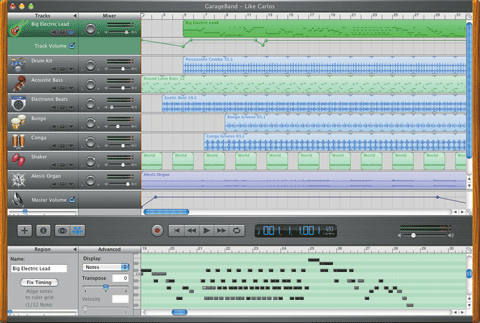
Being compatible with Garage Band was important as we used it for all our sound. I am pretty confident with my knowledge of Garage Band, however Adam was assigned to the role of sound editor. The animatic was useful though, on deciding on some of the sounds in the final product. We used a mixture of our own recordings and already existing “loops” on Garage Band. Adam decided on an original soundtrack, written by Carl Williams for an original soundtrack. We did use some of the loops I had used in the animatic though, for example the birds singing in the park scene. Our own sounds and voiceover were all recorded onto a tape recorder then transferred and placed onto garage band. Without the clipping and editing abilities of garage band we would never have got the voiceover right, and it did take a while to perfect.


Overall I feel I have consolidated on skills I learnt last year and improved in many other ways. This year’s production is better and I had a clear idea of what we were doing from the start. This was mainly due to my group being great time keepers and all available when we needed to discuss or improve something. Above all our film was of a much higher standard this year than the previous and i think we all executed our roles in the group extremely well.


Evaluation Part 4 - Dom

How did you use new media technologies in the construction, research, planning and evaluation stages?
In the whole process of researching, planning, filming and editing all our products we usesd a vairety of different new media technologies:
  • The internet - BBC iplayer for Shorts(http://www.bbc.co.uk/filmnetwork/), Virgin Media short (http://www.virginmediashorts.co.uk/) - For research and Planning.
  • Blogger - To record all the processes of the Main product and ancillary tasks.
  • Sony HD camera - To film
  • Voice recorder - Recording the voice overs and some foley
  • Final Cut Pro - Image editing, titles and credits.
  • Garage band - Sound
  • Photoshop - Poster editing and Review
  • DaFont website (http://www.dafont.com/) - for title font on poster
  • InDesign - Review
  • Facebook - Audience feedback on all stages of the coursework.
My role in the group was: 
  •  Cameraman
  • Props manager
  • Location manager
  • Editor
  • Poster creator
The Internet
The Internet has become a useful for people all over the world. It is a relatively new media technology that has become one of the building block for thousands of businesses, helped people to socially network with people from all around the world and has become a tool that people everywhere use daily. 
The internet has provided me with so much throughout all the stages of this portfolio, ranging from short films for my research that I could watch online to information about short film distribution and the change in British social realism in the last 10 years. I used the internet to: 
  • Watch the short films that I have written posts about previously (http://advancedportfoliosmalley.blogspot.com/2010/01/dom-fade-to-black-research-and-planning.html)
  • To blog all all the stages of the project using the blog service blogger
  • To gain the font for title and credits and the film and also the title of the poster.
  • Google images gave us the small images on the review (Tweedledee and the cards.)
  • Youtube has been used to upload our animatic and final product and also for audience feedback.
  • Social networking sites have been a great source for gaining ideas for the name of the film and also for more audience feedback.
Sony HD Camera
The Sony HD camera we used was provided to us by the college. We were lucky enough to have the use of the HD camera as some people had to use regular hand held cameras . The quality that you recieve from the HD camera makes such a massive difference to the finished piece as it makes it look much more professional and like a proper short film. The camera was easy to use and because I was the cameraman I am grateful that we were allowed to use it. The camera itself has a excellent white balance that madea real difference on our ilm as last year I had a problem with the white balance on one of the othe camera's due to the weather constantly changing whilst we were filming.

Final Cut Pro
We chose to use final cut as it is a much more professional programme to the alternative we had which was IMovie. Also I have Final cut express at home which is a very similar programme and used Final last year for my foundation portfolio and also for my Film AS film this year so i know my way around the programme.


We Created the film by: 
  • Importing all footage from the camera into Final Cut
  • Next we dissected the different shots using the slice tool.
  • We then chose the shots we wanted and put the ones we didn't back into the library of clips in case we decided to use them.
  • We then ordered the clips by dragging and dropping them into the order that the shot list and animatic had laid out.
  • We had to edit some of the shots to make them longer and shorter. For example the scene when Tom is eating the pizza we used the speed tool to cahnge the speed of the pizza disapearing to make it a lot quicker (balancing it with making it still look realistic.) and also the bits when he is eating the pizza is slowed down using the same tool.
  • To put the film altogether we used a mixture of cross dissolves and fade in and out's to keep the film flowing. The fades in and out are usual used when it is going from the park and real time to their internal monologues. and the cross dissolve was a really nice visual image for the scene when Kate is writting in her diary on her bed. 
  • Next we put in the title using the text tool and placing it in the bottom right hand corner when the couple are in the park. We did this by putting the text layer on top of the video layer and placing the writting where we wanted it. 
  • The credits were easy to do as they were just text on a black background.
 Garageband


(Above is a Youtube tutorial of how to use Garageband for a Mac.)
Garage band is a sound editing software tool that has various different aspects, ranging from recording live music tracks to film sound and foley. We used garage band to put all the sound diegetic and none diegetic into the piece.
What we did: 
  • Imported the pre recorded voices that we recorded using the voice recorder and the video.
  • Cut and split the track to enable use to move it around to fit the piece well.
  • We then added another lay and imported the music that was recorded using the voice recorder thanks to Karl Williams (who is also the voice of Tom).
  • We cut the music to come in and out at the rtimes we wanted and also had to copy and paste a tiny section of it to make it sound right as it faded out.
  • We made it fade out by adjusting the levels of the track.

 Photoshop
 http://www.5min.com/Video/Photoshop-Video-Tutorial-Chroma-Keying-3768921
Above is a link to a Photoshop tutorial
Adobe Photoshop has become a brilliant tool that lots of professional photographers and publishing companies use. The programme is designed for image manipulation and editing. We used Photoshop in both our poster and our review and it was a brilliant tool to have. 
How we used Photoshop (Poster):
  • We imported the image that we wanted to use.
  • Cropped the image by setting the page size to a A3 portrait and Adjusting the size of the photo to fit the frame.
  • I then added lots of layers into the project in order to put the text etc.
  • and the poster was made
 How we used Photoshop (Review)
  • Imported the picture of Tom and Kate in bed
  • Then created text boxes for the directed by, title, etc
  • We then inserted the pictures of Tweedledee and the cards
  • Next we used the colour replacement tool to change the colour of the cards from standard red and white to the themed colour of green and orange.
Social networking sitesI used Social networking sites in order to gain audience feedback and for research and planning. 
I created a group on Facebook dedicated to the the project and made all the other members of the group admin to the group so they could change things around and update it as the wish. We uploaded the video to this group to gain audience feedback. The idea for the film was copied onto the group and we received feedback on that and also people were given the chance to help us decide the name. The film was also put in the group and we got feedback from that. I also posted the video on my status and i gain the majority of my feedback from that.


Evaluation Part 1 - Adam RUTHERFORD

In what ways does your media product use, develop or challenge forms and conventions of real media products?
The whole idea and concept of our film was to challenge the conventions of the typical Rom-Com template and treat it as social realism. Through the narrative and directorial style we have gone for, I believe we have succeeded in this aim, and created something that challenges it's genre while also managing to adhere to it's rules.

Social Realism cinema in Britain began in the early 1900's, influenced by Italian Neorealism, an art movement which aimed to show film as a view on real life. Cecil Hepworth's "Rescued by Rover (1905)" was pioneering for the genre as it captured Edwardian England perfectly, relating to everyday people who went to see it. Another example is James Williamson's "A Reservist before the war, and after the war (1908)" which is considered to be the first British film which used it's social realism as a protest against society. This theme has carried on through to the 21st century where social realism is used to raise issues such as race, class and poverty.

The main ideas of social realism (discussed above) appealed to us when making "Three Words" as we wanted to make a rom-com which an audience could relate to. When writing the script we decided we would discuss a more truthful representation of what teenage relationships are really like, rather then the extreme examples many films and TV programs (C4's "Skins" (see link below) is a perfect example) depict them as. Despite this we realised that the best way to show this would involve slightly stepping outside the usual barriers of social realism, and hence where we challenged the conventions of a real media product.


The typical conventions for a social realism film are:
  • Camera
    • Hand-held camera scenes to make the audience feel like they are observing the scene in real life
    • Establishing shots to show the audience the real locations
    • character close-ups to emphasise emotions in a realistic manner
    • shot's filmed at eye level to help the audience relate to the characters
    • off framing shot to give the film a more realistic feel 
    • Group shots (see above)
  •  Mise En Scene
    • Naturalistic lighting in order to give the film a more authentic, less manufactured theme. 
    • Costume and make-up dependant on the character's surrounding, class and lifestyle
    • Parts of script left up to actors to improvise making the dialogue seem natural and reactions genuine
    • Actors normally unknown making their performance more believable 
    • Props dependant of character and their gender, personality and most importantly class.
  •  Sound
    • Accent usually working class, dialect relevant to surroundings. 
    • Diegetic sounds can be heard to make the audience feel like they are there
    • Non-diegetic sounds mainly kept to a minimum so as not to direct attention away from reality
Our film managed to keep to most of the conventions, especially to do with mise-en-scene and camera-work, however there are many parts of our film where we stretched the usual techniques used in social realism. The conventions we used in "Three Words" are:

  • Camera
    • A mixture of static and hand-held camera shots
    • Mainly medium shots filmed to help the audience relate and feel closer to the characters
    • kept to the 180 degree rule
    • Long shot's to show the couple's togetherness, and in parts the distance between them.
    • camera begins one scene out of focus, then as it moves across it comes back into focus 
All of our shots with exception to the last one fit into the techniques used in social realism. Because the camera starts the scene out of focus it takes away the reality of the scene. This is the same with the fade outs we used in the same scene. In order to make the film seem like reality we used a hand-held camera to shoot a couple of shots. This helps the audience feel like they are observing inside the film and make it feel real.
  • Mise-en-scene 
    • Naturalistic lighting such as sunlight and lights in the house. No lighting aides used
    • Costume and make-up relevant to the characters and surroundings (middle class, Haywards Heath). 
    • Props relating to characters personality's - Dominoes Pizza, cigarettes etc
The mise-en-scene is again accurate to the the usual conventions used in social realism films. Most social realism is based around working class protagonists, however we challenged this convention by writing a script with a middle class couple in mind.
  • Sound
    • Non-digetic sounds throughout (Voice-overs, soundtrack)
    • Only diegetic sound is the TV in the last scene, and the birds at the start
    •  Accents in relation to where they live
Sound was probably where we challenged social realism conventions the most, mainly through our use of voice-overs and lack of diegetic sound. We wanted to tell the story through voice-overs to help tell the untold story of the protagonists relationship. Even though everything looks good on the surface, there are conflicting emotions going through both characters. Despite this taking some of the reality out of the story (a key factor of social realism) we feel we justified our decision as it brought something new and different to the film and gave it the depth it needed.

When making the film we took inspiration from other British Film directors who are known for making social realism films. For example Andrea Arnold is known for her use of hand-held camera to emphasise realism in her films. This technique makes the audience feel like they are taking part in the film as the hand-held camera seems to be like a point-of-view shot.

In the film "Looking for Eric", Ken Loach studies the main character Eric Bishop, and all the problems he has in his life. Eric Bishop begins seeing his footballing hero Eric Cantona who, acting as his conscience helps him overcome his problems. I really like how Leigh stepped outside the conventions of social realism to study Eric's character, a technique that we incorporated in our film by using voice-overs to tell us what Tom was really thinking. 
 
Poster
When designing our poster we studied other British films posters in order to draw inspiration:
  • Shane Meadow's 'Somers Town' has the perfect poster to represent it's film. This is because of it's  mainly black and white background with parts of very saturated colour in it. In my opinion the black and white represent urban London where the boys live, whilst the bright colours connote the boy's dreams of getting out of London. We took the idea of a black and white background to add bits of colour to our as well (see poster on other post), making two or the bricks red; A direct nod to 'Somers Town'.
  • "Ken Loach's "Looking For Eric" is another poster which I drew a lot of inspiration from when helping to design ours. In the poster, Cantona is in black and white and is very saturated, whilst Bishop is in complete colour looking at him. In our poster w have take basically the same idea, of Kate looking at Tom for guidance as he looks the other way.  


I believe we've combined the elements of social realism with our original ideas to create a hybrid of social realism, and rom-com, two genres normally set very far apart from each other.

        Thursday, 29 April 2010

        Evaluation Part 2 - Dom

        How effective is the combination of your main product and your ancilliary tasks?


        We have done 2 ancilliary tasks as well as a main short film product.  The two images either side of this text are (to the left) our film poster for the short film Three Words and (to the right) a review of our short film in the format of Little White Lies Magazine. These two products would be used to disrupt and get the film known if we were to release the film properly.


        Film Poster
        The film poster is aimed at a demographic of 16-24 year olds and would be a part of the distribution arm of the film process. We used photoshop with various layers, texts and images to create the poster. We had loads of ideas for posters and some of them are posted earlier:
        In the end none of the exact poster ideas were used but different aspects were. For example in Adam and Keira's film poster idea there is one single image used that hints at what the film may be about without it being to obvious or cheesy. Orginally we were going to do two teaser posters that are used to tell the audience that the film exists but gives away hardly anything so they gain interest in what it may be. For the teaser poster we were going to us mine and Adam's ideas. However both the ideas gave away to little and mislead the audience in what the film is actually about. After discussing it as a group we decided that the best idea was to have a single image of them both in it as they are the protagonists and are what the story is about. This idea was based on lots of other social realist film poster; a perfect example is the early "Looking for Eric" posters. In which we see the main character Eric looking up in admiration at in a almost transparent desaturated image of Eric Cantona. Hinting at but not telling the audience bluntly what the characters relationship is.
        In this way we got our two protagonists and took a few more photos, the images we got were good and we chose the one you see in the poster with them leaning against a wall.
        Key Features of the Image
        • Kate looking up at Tom ( Symbolises her feelings for him and shows that she reall likes him)
        • Tom is looking away from Kate, almost avoiding any eye contact at all. This combined with Kate looking up shows that there is interest from her and not from him.
        • To enthusias this Tom has his hands in his pocket where as kate has her hands around his back and clinging on to his arm.
        • The use of the bricks in the background is very common in social realism as it is symbolic of Britishness.
        • The colour scheme in the picture is also interesting as Tom is wearing very bland, plain colours whereas Kate is also wearing grey clothes but with a red scalf. The colour red itself is often a symbol as being the colour of love and the heart, this shows her love for Tom.
        The critisms I have with this image is the apple that Kate has in her right hand is un-necessary and not in her character at all. Also the image is very bland and boring and doesn't really attract the audience's eyes. Taking this into account our next step was to import this image into photoshop and I cloned the brick next to the one that the apple is covering and used this cloning tool to copy over the apple.


        The theme of the poster is shown in the image and title the best. The poster clearly demonstrates that the two people in the poster are either in a relationship or there is some feelings from Kate towards Tom. The font of the title for the poster is good at telling the audience a little bit about the genre and what might happen. The way that the hearts at the beginning of the words aren't the typical heart you would expect to see in a romantic or romantic comedys. It shows us that it is not a typical love story and there is something not right about the final product.

        Review
        The review for our film was in the style of a review from Little White Lie Magazine. The format of Little white lies is interesting as the theme for the magazine is based around the film on the front cover, for example in the edition where Kickass is on the front the colour scheme is green and yellow and there are little comic book superhero pictures on some of the pages. In this way we based the front cover on a film that was big at the time, Tim Burton's "Alice in Wonderland". 
        To keep within the theme of Alice in Wonderland we had the colour scheme of green and orange as to match Johnny Depp's mad hatter. 
        • The boxes with the name of the film and who it was directed by are in orange and green.
        • We inserted cards onto the top right hand side which we used photo shop to colour in the green and orange. 
        • We added in pictures of Tweedledee as poking out of the side one of the boxes.
        • Also at the bottom of the page where the number is is a card spade next to the number. 

        Text
        • It keeps to the conventions of the magazine in the way that it is laid out.
        • Is intellectual and uses good film terms that are typical of the magazine.
        • Reviews at the bottom are accurate to the theme. 
        • The text in the review well represents the finished product and gives the audience a snippet of what the film is about without giving to much away
        Overall I believe that the review and poster work well with the final product and actually complements it. I think this because the way that the review is written and formatted is realistic and believable to the style of Little White Lies magazine. Plus the poster is effective in capturing the audiences eye through the use of colour and image. The poster and review both give the audience only a small idea of what the film is about without telling them too much.


        Evaluation part 4 - Adam RUTHEFORD

        How did you use new media technologies in the construction and research, planning and evaluation stages?
        Technology played a major role in every stage of our film making process, from the original research right through to putting the product on disc. This is also the case with both Ancillary tasks. Looking back on the work I have done I feel much more confident using media technology and feel I have honed my skills well. The following document where I used technology in my product:

        Initial Research
        Before we came up with the idea for our film I did a lot of research on British short films, analysing them, and working out what short-film conventions they used in order to help me with my product. To do this I used the BBC film network (http://www.bbc.co.uk/filmnetwork/) which allowed me to access hundreds of short films. New technology such as this and the BBC's iplayer have completely revolutionised how people watch TV and film, as people can just watch it at any time and don't even really need a television any more. 

        Planning
        • The main source of technology we used while planning our film was a stills camera. We used this to take pictures of our location in order to assist us with our storyboard and to give us a better idea of the lighting and space that we'd be dealing with. The stills we took can be found in the January section of this blog.
        • We decided to do our storyboard as an animatic, using a camera to film the shots we'd drawn. We wanted to do it this way because not only would it be easier to load on to the blog, but it is also a better way to get an idea of how long each shot we filmed would be.
        • The social-networking site Facebook was incredibly useful in getting ideas and feedback for our original idea. We created a group on Facebook and gave our audience a choice of two titles: "Three Words" or "Shit". Without this technology we would not have been able to interact with our audience in such a way, which would have also been disastrous for our feedback we received after finishing the film.


        Filming
        • Filming our product was the first time I have ever used a HD camera before. We decided to use this as we wanted our film to be as high quality as possible in order to end up with a more professional finish on our film. On first using the camera I had to re-teach myself all the things I could do on the XM2 cameras such as:
              • Set the white balance
              • learning how to record and what back the footage
              • inserting and ejecting the tape
              • setting the contrast, brightness and focus
                  The latter of these turned out to be a very important feature as we changed the focus in certain scenes (the scene of Kate in her bedroom is a perfect example) in order to capture certain moods.

        Editing
        • To edit our film we used the apple program "Final Cut Pro".  I have used final cut many times before as it is an incredibly advanced tool which many major studios use to edit. The functions on it allow us to not only cut and paste scenes together, but also to create titles and credits, different types of cuts (fades, wipes etc) and even the image itself. I found final cut the most useful in the scene I directed where Kate is in her bedroom writing in her diary. I invisiged her sitting in her bedroom, fading out and then in again but sitting in a different position, a technique used by many directors when showing time passing. By using final cut I was able to do this, and ended up creating an effective scene which served it's purpose completly.
        • To edit the music I used Garage Band, another apple product, and another program which I am experienced in using. The beauty of Garage Band is that not only can you create your music, but there are also many pre-set instrumental pieces, as well as a vast library of sound effects. We decided to record our own piece of music for this film, as we wanted to give our film an original sound that people hadn't heard before. We recorded Carl Williams playing acoustic guitar through the program; a piece we ended up using at the beginning and end of our film. We also used garage band for the voice-overs, recording and Keira and Carl speaking into a tape recorder then uploading their voices onto Garage band and editing them into the respective parts of the film. The clips you hear on the TV at the end were both recorded using a tape recorder which we then transferred onto an ipod, and then onto Garage Band. We took the clips (Gavin and Stacy and Scrubs) off of youtube and put them onto GarageBand to keep up the pretence that the protagonists are watching TV. 

         
        Review
        • To create the template of the review we used Adobe InDesign, a program used mainly by designers and graphics production artists. With the use of this program we were able to successfully create an authentic looking template for our Little White Lies magazine review. Because it was the first time I had used InDesign it took me a while to work out all the functions for it, however once I did I was able to progress pretty quickly. Keira and myself each made a different once which would both suit the magazine and in the end we went for her template as it was more professional looking (see above). We also used InDesign to format our text into the four columns and the section at the bottom for ratings.
        • As well as InDesign we used another Adobe program called Photoshop to edit the 'Alice in Wonderland" images. To do this we copy and pasted the images onto Photoshop then changed their colours and size to match the typical style that Little White Lies adhere to. The text boxes at the top of the review were also created and manipulated using Photoshop to get the correct colour scheme. 
        Blog
        Since I began this project I have updated the group blog to explain everything I have been doing. The blog we have been using is http://www.blogger.com, "a blog storage system that allows private or multi-user blogs with time-stamped entries" (Wikipedia). Keeping a record of everything has been made much easier through the use of the blog, making it a perfect reference point if we need to find anything that we have done in the past.


        I have gained a lot of useful skills during the making of this film, particularly with technology and in that particularly with the HD camera and the editing program InDesign.